


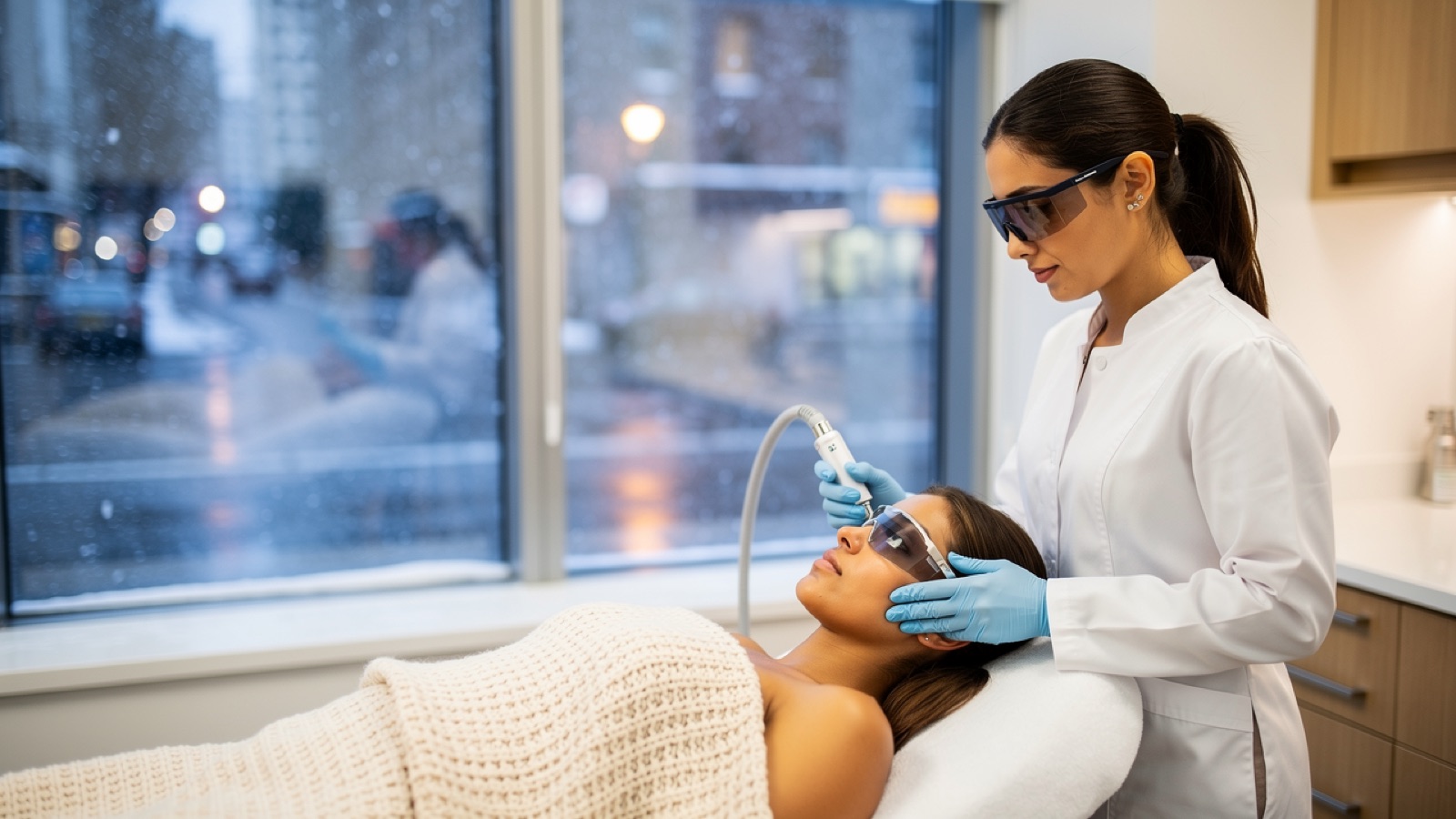
Clinical review: Shahmeen Irshad, MD, internal medicine physician and founder of Amara Medical NYC, Staten Island, NY. Updated November 2026.
The best time to start skin resurfacing in New York is late fall through early spring, because the UV index in December and January sits around 1 to 2 and a tanned face is one you cannot safely treat.
As for which device: in a split-face trial, fractional micro-plasma radiofrequency, the technology behind Opus Plasma, improved acne scars about as much as a CO2 laser, with no dark spots on the plasma side. In another trial it beat RF microneedling, the category Morpheus8 belongs to, on scars, but it hurt more and the redness lasted longer. At Amara Medical NYC in Staten Island, we offer Alma Opus. This guide gives you a month-by-month plan for the season and an honest comparison with the two devices people ask about most.
Why winter is resurfacing season in New York
The American Society of Plastic Surgeons calls fall and winter "laser season," because that is when people get the least sun [1]. Two rules drive it.
- You cannot be treated with a tan or sunburn. The American Academy of Dermatology is direct about it: if you arrive tanned, the treatment is off, because the energy could burn or discolor your skin [2].
- Healing skin must be kept out of the sun. Freshly treated skin that gets sun can scar or darken [2][3].
New York's winter makes both easier. NOAA's 2025 daily UV chart for New York shows the index in the low range, about 1 to 2, through December and January, compared with about 9 to 10 in June and July [4]. Low UV does not mean you can skip sunscreen after resurfacing. It means SPF 30 or higher, shade and sun-protective clothing actually keep up with your exposure [22].
A winter resurfacing calendar
Here is a plan that fits a typical Staten Island winter. Your own spacing will depend on what Dr. Irshad recommends at your consult.
| When | What to do | Why |
|---|---|---|
| Late November | Consultation and skin check | Sets the plan, the number of sessions and which Opus applicators fit your goals |
| 2 to 4 weeks before session 1 | Stop retinoid and glycolic acid products; quit smoking at least 2 weeks ahead [2] | Lowers irritation and helps healing |
| Before your session | Take cold sore medicine as prescribed if you get cold sores [2] | Resurfacing can trigger a flare |
| December or early January | Session 1 | Lowest UV of the year [4] |
| Week after each session | Keep treated skin out of the sun; SPF 30+ once healed [2][22] | Redness, mild swelling and tiny marks fade over a few days |
| January to February | Session 2 | Trials used three sessions; one spaced them two months apart [5][6] |
| March | Session 3 if planned | Finishes the series before summer sun |
| April onward | Daily SPF, results check | Results can keep improving over weeks and months [23] |
Planning around an event? Amara's own guidance is that redness, mild swelling and tiny marks can show for a few days [23]. We suggest leaving at least a week between a session and holiday photos, a wedding or a big work presentation.
Ready to map your own dates? Call (347) 934-3244 or send us a consultation request.
Opus Plasma vs Morpheus8 vs CO2 compared
All three wound the skin in a controlled way so it rebuilds collagen. They do it differently, and that changes downtime and risk.
| Opus Plasma (Alma) | RF microneedling (e.g., Morpheus8 by InMode) | Fractional CO2 laser | |
|---|---|---|---|
| How it works | Radiofrequency pins create micro-plasma that ablates tiny channels and heats around them [8] | Pins go into the skin and deliver radiofrequency heat at depth [9] | Ablative laser treats tiny columns of skin |
| FDA-cleared wording | "Ablation and resurfacing of the skin" [8] | Soft tissue coagulation/contraction; above 62 mJ per pin, limited to skin types I to IV [9] | Varies by brand |
| Depth | Not published in mm by Alma | 1 to 4 mm on face tips [10] | Varies by device |
| Typical recovery | A few days of redness and swelling (Amara); longer redness than RF microneedling in a trial [6] | 1 to 5 days per InMode [10] | Generally up to two weeks [3] |
| Acne scar results | Matched CO2 in one trial [5]; beat RF microneedling in another [6] | Similar to CO2 after one session in a small trial [11]; slightly behind CO2 in one meta-analysis [12] | Ranked second of six for efficacy, behind Nd:YAG, in a network meta-analysis [13] |
| Dark-spot (PIH) risk | None vs 36% on the CO2 side in a 33-patient trial [5] | Lowest PIH ranking of six devices [13] | Highest PIH ranking; more than 4 times the risk vs RF microneedling [12][13] |
| At Amara | Yes | No | No |
Pick Opus Plasma if you want real resurfacing for texture, fine lines or rolling acne scars and can handle a few days of redness, with lower pigment risk than CO2.
Pick RF microneedling like Morpheus8 if the shortest recovery and lowest pigment risk matter most to you [6][13].
Pick fractional CO2 if you want the most-studied ablative option, can plan for up to two weeks of recovery, and have lighter skin [3][13].
What the evidence on Opus Plasma really covers
Most clinic pages say "studies show" without naming any. Here is what exists.
No peer-reviewed study we found names Alma Opus as the device. The trials are of fractional micro-plasma radiofrequency, the technology Opus Plasma uses, and most were done in Chinese or other Asian patients [5][6][14][15]. Alma itself cites a 2013 study as its evidence [16], and that study was published seven years before Opus launched in North America in 2020 [17].
What those studies found:
- Versus CO2: In 33 Asian patients with acne scars, three split-face sessions improved scars 56.4% on the plasma side and 59.2% on the CO2 side, not a significant difference. Twelve patients (36.4%) had dark spots after CO2; none did on the plasma side [5].
- Versus RF microneedling: In 60 patients, plasma lowered acne scar scores more (41.33 vs 32.17 points), especially rolling scars. Plasma was more painful and its redness lasted longer [6].
- After one session: In a 79-patient review, 35.4% improved moderately to excellently after a single treatment. Icepick scars and severe scarring responded less [15].
Alma also advertises about 50% less downtime than CO2 [16]. That figure does not appear in the abstract of the study Alma cites, so treat it as a manufacturer claim.
Skin tone changes which device is safest
Darker skin has more melanin, and melanin competes for the energy, which raises the risk of dark patches, light patches, blisters and scarring after resurfacing [18]. A 2026 review in the Journal of the American Academy of Dermatology found ablative treatments carry higher complication rates in skin of color, and recommended strict sun protection and lower-energy sessions in a series [18].
How that plays out:
- CO2 had the highest pigment-darkening risk of six devices in a network meta-analysis [13], and one small study in Asian skin found dark spots in 55.5% of patients at one month, easing to 11.1% at six months [19].
- RF microneedling had the lowest [13], although Morpheus8's FDA clearance limits its higher energy settings to skin types I to IV [9].
- Opus Plasma showed no dark spots in the 2013 trial and one case in 60 in the 2021 trial, both in Asian patients [5][6]. Alma says Opus is suitable for skin types I to VI [20], but we did not find published data in the deepest skin tones.
Dr. Irshad's bio highlights her experience treating diverse skin tones with tailored laser modalities. If you have brown or Black skin, ask at your consult how she will adjust energy and spacing for you, and expect a more gradual plan.
How many sessions and how much downtime to plan for
Most of the micro-plasma trials used three sessions [5][6][14]. Some people with mild texture need fewer. Deep or icepick scars often need more, or a combination with other treatments [15]. A 2026 analysis of 56 trials found combination plans generally beat single treatments for moderate to severe acne scars [21].
At Amara, a numbing cream goes on first, and most people feel warmth and a mild prickling. Expect redness and mild swelling for a few days, and tiny marks as the skin heals. Results keep improving over the following weeks and months as new collagen forms.
Prep and aftercare rules that do not change with the season
These come from the AAD and ASPS and apply to any resurfacing:
- Stop retinoids and glycolic acid 2 to 4 weeks before [2].
- Stop smoking at least 2 weeks before [2].
- Take cold sore medicine ahead of time if prescribed [2].
- Protect healing skin from the sun, then use SPF 30 or higher every day [2][3][22].
- Expect dryness and peeling as the surface renews [3].
Results take time. The AAD notes it can take months to see the full effect of laser scar treatment, with little change at first [2].
Resurfacing at Amara Medical NYC
Amara uses the Alma Opus platform, which has four applicators, so your plan can be tailored [23]:
- Opus Plasma for resurfacing and texture.
- UniLarge for deep heating and tightening.
- UniFace for facial tightening with a massage ring.
- Coaxipolar for thin or bony areas.
We treat the face, neck and décolleté.
If acne scars are your main concern, our posts on treating acne scars and acne scars vs injury scars cover other options we combine with Opus.
Amara Medical NYC is at 1756 Richmond Ave, Staten Island, NY 10314. To start this winter, call (347) 934-3244 or request a consultation, and see our Alma Opus page for more.
FAQ
Is Opus Plasma better than Morpheus8?
For acne scars, one 60-patient trial found micro-plasma radiofrequency improved scars more than RF microneedling, but with more pain and longer redness [6]. RF microneedling had shorter downtime and fewer side effects [6] and the lowest pigment risk [13]. The trials did not name the brand-name devices, so the choice depends on your skin and how much recovery you can take.
How long is Opus Plasma downtime?
Expect redness and mild swelling for a few days, plus tiny marks while the skin heals. That is shorter than the up to two weeks typical of CO2 resurfacing [3].
Can I get Opus Plasma in summer?
Not if you are tanned, and healing skin has to stay out of the sun [2]. That is why late fall to early spring, when UV in New York is lowest, is the easiest time to resurface [1][4].
Sources
- American Society of Plastic Surgeons. Treatments to refresh your skin after summer. 2025. https://www.plasticsurgery.org/news/articles/treatments-to-refresh-your-skin-after-summer
- American Academy of Dermatology. 10 things to know before having laser treatment for your scar. https://www.aad.org/public/cosmetic/scars-stretch-marks/laser-treatment-scar
- American Society of Plastic Surgeons. Laser skin resurfacing recovery. https://www.plasticsurgery.org/cosmetic-procedures/laser-skin-resurfacing/recovery
- NOAA Climate Prediction Center. Daily UV Index, New York, NY, 2025. https://www.cpc.ncep.noaa.gov/products/stratosphere/uv_index/uv_annual.shtml
- Zhang Z, et al. Fractional microplasma radio frequency vs CO2 fractional laser for atrophic acne scars: a randomized split-face study. Dermatol Surg. 2013. https://pubmed.ncbi.nlm.nih.gov/23379344/
- Lan T, et al. Fractional micro-plasma radiofrequency vs fractional microneedle radiofrequency for atrophic acne scars: a pilot randomized split-face study. Lasers Surg Med. 2021. https://pubmed.ncbi.nlm.nih.gov/33326634/
- Tan MG, et al. Radiofrequency microneedling: a comprehensive and critical review. Dermatol Surg. 2021. https://pubmed.ncbi.nlm.nih.gov/33577211/
- US FDA. 510(k) K201520, Alma Opus System, Colibri applicator and tips. 2021. https://www.accessdata.fda.gov/cdrh_docs/pdf20/K201520.pdf
- US FDA. 510(k) K231790, InMode System with the Morpheus8 applicators. 2023. https://www.accessdata.fda.gov/cdrh_docs/pdf23/K231790.pdf
- InMode. Morpheus8 quick reference guide. 2021. https://cdn.shopify.com/s/files/1/0313/4901/4660/files/QRG_Morpheus8_ROW_May_2021docx.pdf (manufacturer)
- Hendel K, et al. Fractional CO2 laser vs microneedle radiofrequency for acne scars: a randomized split-face trial. Lasers Surg Med. 2023. https://pubmed.ncbi.nlm.nih.gov/36934435/
- Argobi Y, et al. Fractional CO2 laser vs microneedling radiofrequency for post-acne scarring: a meta-analysis of RCTs. J Cosmet Dermatol. 2026. https://pubmed.ncbi.nlm.nih.gov/41821146/
- Wang Y, et al. Comparative efficacy and safety of six photoelectric therapies for atrophic acne scars: a network meta-analysis. Indian J Dermatol Venereol Leprol. 2023. https://pubmed.ncbi.nlm.nih.gov/37067138/
- Han J, et al. Treatment of atrophic acne scarring with fractional microplasma radiofrequency: a multicentric experience. JPRAS Open. 2024. https://pubmed.ncbi.nlm.nih.gov/38868740/
- Li J, et al. Clinical factors influencing the effectiveness of microplasma fractional radiofrequency for atrophic acne scars. J Cosmet Dermatol. 2024. https://pubmed.ncbi.nlm.nih.gov/38532647/
- Alma Inc. Opus product page. Accessed November 2026. https://almainc.com/product/opus/ (manufacturer)
- Practical Dermatology. Alma rolls out Opus Plasma. January 2020. https://practicaldermatology.com/news/alma-rolls-out-opus-plasma/2460264/
- Dreifus EM, et al. Laser and energy-based device use in skin of color: a clinical review. J Am Acad Dermatol. 2026. https://pubmed.ncbi.nlm.nih.gov/42660430/
- Chan NP, et al. Fractional ablative CO2 laser resurfacing for skin rejuvenation and acne scars in Asians. Lasers Surg Med. 2010. https://pubmed.ncbi.nlm.nih.gov/20976801/
- Alma Lasers. Opus. Accessed November 2026. https://almalasers.com/opus/ (manufacturer)
- Ou Y, et al. Laser, microneedling, and combination therapies for moderate to severe acne atrophic scars: a network meta-analysis. Aesthetic Plast Surg. 2026. https://pubmed.ncbi.nlm.nih.gov/42429955/
- American Academy of Dermatology. Skin conditions that lasers can treat. https://www.aad.org/public/diseases/a-z/skin-conditions-lasers-treat
- Amara Medical NYC. Alma Opus skin rejuvenation. https://www.amaramedicalnyc.com/services/alma-opus-skin-rejuvenation
This article is for education and is not medical advice. Results and recovery vary, and a consultation is needed to decide whether resurfacing suits your skin.

